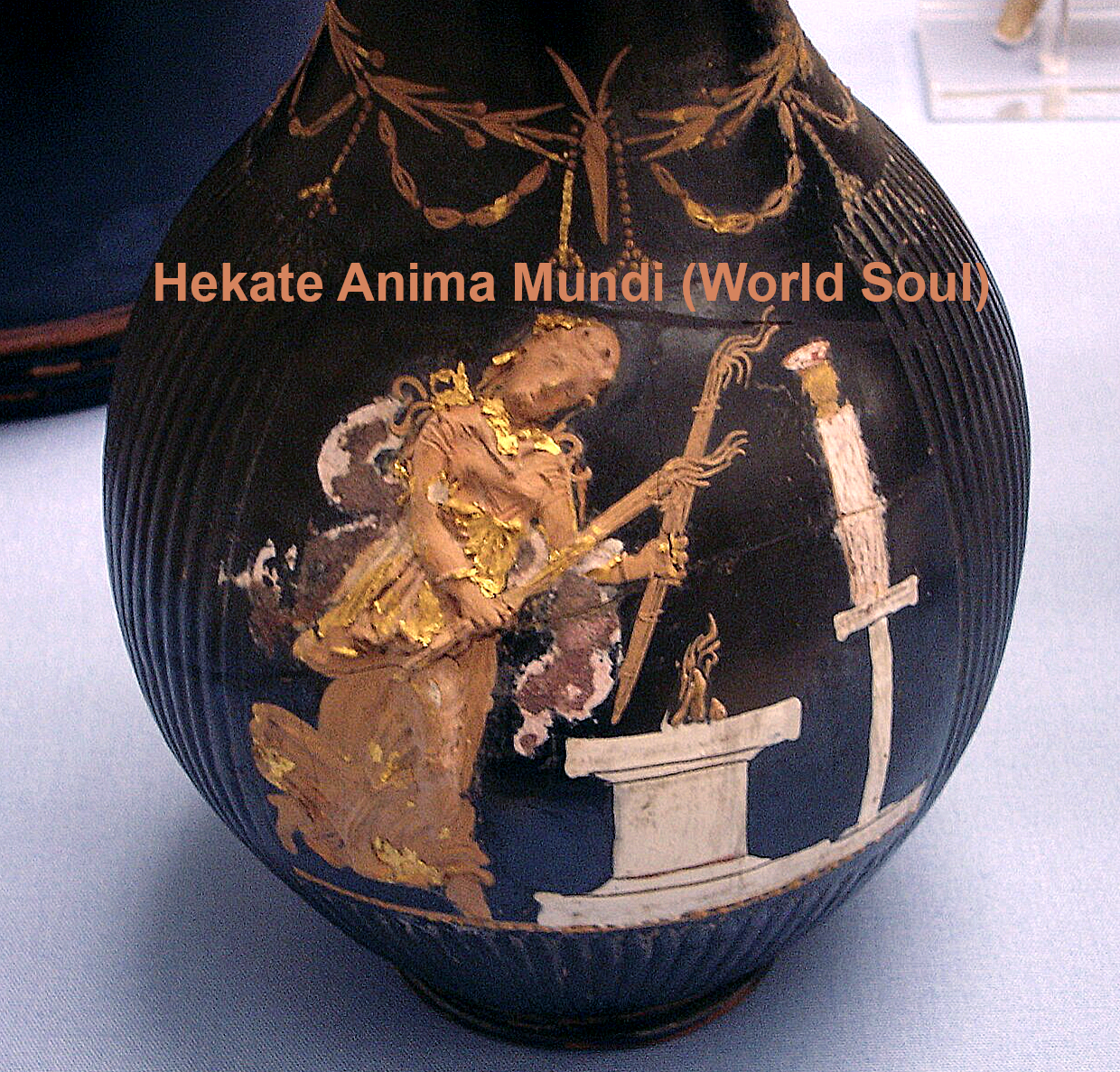
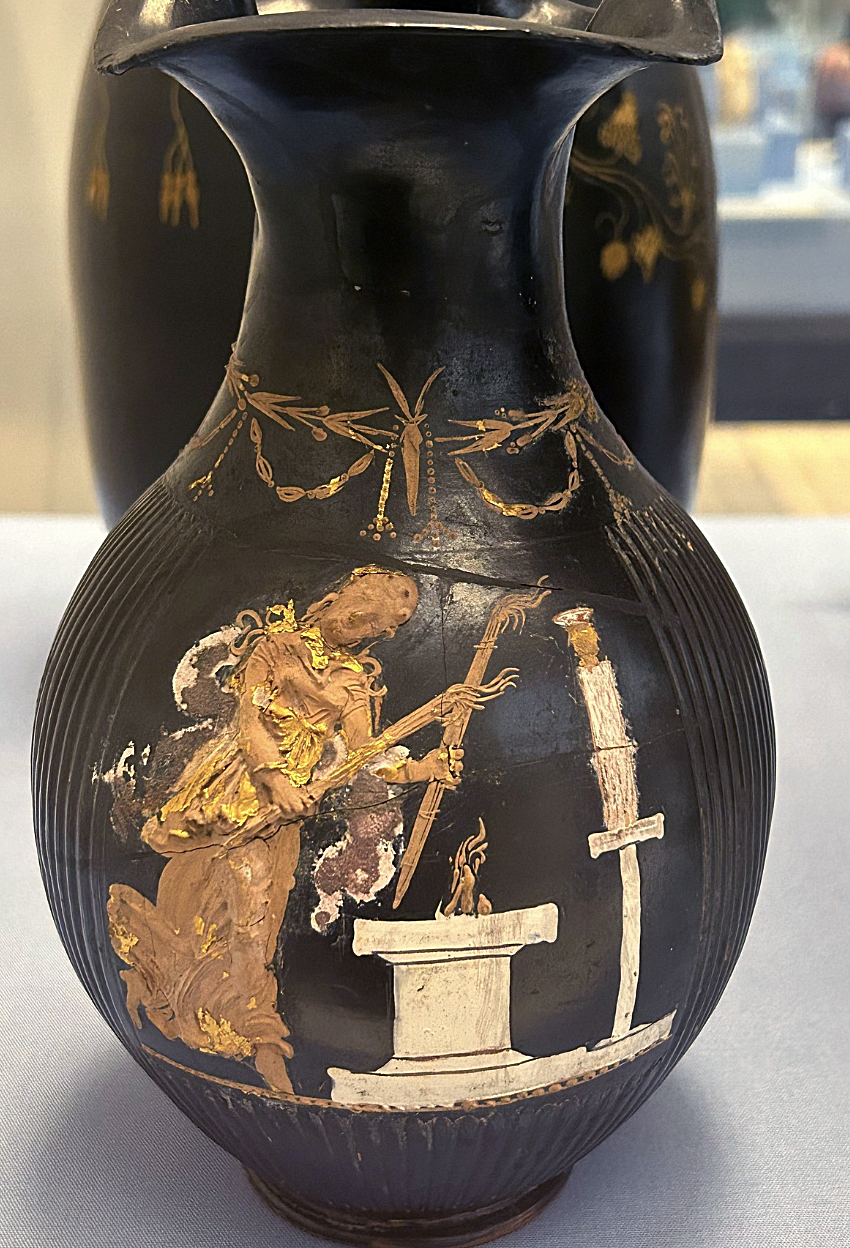
Beautiful relief of Hekate holding torches in front of an altar on an oinochoe wine jug with laurel wreath decoration, about 350-300 BCE, Capua, Italy.
In 2018 I began research for my forthcoming book Synthēmata & Symbola ~ Recovering Our Symbolic Imagination with the Magical Practice of Synchromysticism through Esoteric Traditions, Myth, Oracles, & Archetypes. I thought I’d share its “working” Preface.
“For the Paternal Intellect has sown symbols throughout the cosmos.”
—The Chaldean Oracles: text, translation and commentary, Fragment 108, trans. Ruth Majercik
Hermeneutics is decisive in the interpretation of any historical text, and my own stance toward the fragments of the Chaldean Oracles holds that meaning was not left for humanity to invent, but was sown into the very fabric of the cosmos, and comes to us as revelation. Synthēmata & Symbola begins with a cosmological claim: the ancient Chaldean theurgists held that the First Principle, called the Paternal Intellect, is a fountain pouring forth from the noetic realm primogenial ideas and intelligible forms, manifest as living fire into the life-generating cosmic lap of Hekate, the anima mundi, or World Soul. In the Chaldean tradition, she is understood as Soteira (Savior) and, in Neoplatonic interpretation, as the mother of souls, gods, and angels.
As an intermediary between the divine and humankind, Hekate receives these eternal intelligences and archetypes from their emanating source and carries them across the threshold into the world, sowing them into the fabric of daily life. They are synthēmata and symbola, the divine signatures, tokens, signs, and synchronicities that we perceive through our senses, intuition, and conscious awareness. Recognizing and following them runs through the philosophies of Plato, the Neoplatonists Plotinus and Iamblichus, the Orphic mysteries, the Hermetic tradition, Carl Jung, the Romantic poets, and into the living practice of theurgy today.
This book brings that lineage and legacy together into a single, navigable exploration of what I call the Synchromystic Path, the practice of attuning ourselves to the symbolic language the universe relays to each of us, and learning to recognize it as transmission and invitation. The gods are always inviting us into this experience, to be ignited by synthemata and symbola and to follow them as a multivalent guiding thread through the labyrinth of experience, consciously incorporating their revelation into our personal mythos. This hidden grammar of a living cosmos is dynamic, synergistic, and ancient. Theurgy (Greek: theourgia, "god-work") is an embodiment of this practice: to recognize and follow divinely bestowed symbols is the theurgical path toward what Iamblichus called the ensouled and embodied life. It is humankind's birthright. To engage with this dynamic system is a pursuit we are meant to undertake, a journey of performative magic that flows, as this book calls it, along the synchromystic slipstream.
Tracing the arc of what the Greeks called katabasis and anabasis, the book follows the soul's descent into the depths (often the Underworld) and its luminous return, mirroring the Chaldean/Neoplatonic schema of the divine descent from the One through the seven planetary spheres into matter, and the soul's renewal and ascent back to the Divine.
Four myths across five Parts act as lenses on this shared cosmological underlying current and initiatory process:
Part I: Prometheus, in parallel to Hekate’s psychopompic mediation, establishes the foundation with the gift to humankind of symbols enthused with fiery generative power and ontological creativity, grounding the cosmological foundation, and how we open ourselves to continue receiving.
Part II: Parsifal — the young knight walks the Fool’s Journey through innocence, magical thinking, and hard-won compassion, encountering the Grail Castle too soon, failing to ask the crucial healing question of the suffering Fisher King, and learning through long wandering, trial, and initiation the wisdom to return, no longer the naive fool, to ask the healing question and take his rightful place as guardian of the Grail.
Part III: Ariadne moves into occult time, liminal gnosis, and the labyrinth of inner descent, following the thread through shadow and the Dark Night toward the dawning light and the meeting of a god, marking her “destruction" (the abandonment and loneliness of the labyrinth) and her apotheosis and embodiment, shifting Ariadne from the “damsel in distress” to an initiated goddess holding her own thread of fate.
Part IV: Jason & the Argonauts sets sail on the mytho-magical voyage — guided by gifts of the Gods, stars, oracles, the enchantments of Orpheus’ lyre, and the magical assistance of the witch Medea — through trials and wonders toward the dragon at Colchis in search of the Golden Fleece.
Part V: The Divine Wedding, the Fleece & the Grail — the reader arrives at the Golden Return, where Jason’s Golden Fleece, Parsifal’s Holy Grail, and Ariadne’s Jeweled Crown (the constellation Corona Borealis, given to her by Dionysus at their sacred marriage) reveal themselves to be the boon of the same divine homecoming.
All five journeys converge at the Golden Return. Three prizes of the same divine homecoming, and an invitation to step deliberately into one’s own heroic story and to live as the conscious author of a personal mythos in motion.
Ours is the strange and exhilarating task of learning to read the synthēmata and symbola. Woven throughout the book is practical wisdom for how to recognize the moment the slipstream catches you and the journey begins in earnest, and how to cultivate the attention necessary to track the synchronicities, signs, and symbols as they accumulate over time. The deeper practice lies in developing the theurgical discernment to know, with growing confidence, when a symbol carries genuine divine intention and is truly meant to be followed and when it is merely the mind's own wishful projection. The book also addresses the practical dimensions of the synchromystic life, offering guidance for keeping ongoing records and journal entries of the signs, symbols, synchronicities, dreams, strange meetings, and recurring ephemera that mark the path, and for learning to recognize the moment of catapult when the cosmos shifts and the call can no longer be ignored.
Please follow Urania Press on Instagram for updates over the coming months for the publication of SYNTHĒMATA & SYMBOLA ~ Recovering Our Symbolic Imagination with the Magical Practice of Synchromysticism through Esoteric Traditions, Myth, Oracles, & Archetypes.